NaPoWriMo posts
Showing posts with label NaPoWriMo. Show all posts

A Poem for Every Moment

Colour wheel compiled of nature photos

For years, I waited for poems to come to me. I'd coax their arrival with long walks; I'd catch fragments and phrases, and wait patiently for them to build. When it came to writing stories and novels, I'd long since learnt not to wait for inspiration, but I firmly believed poems were different. They were mystical, magical, elusive. If I had an evening to myself, I'd make a Special Occasion of it: light candles, put on music, pull out my notebook and pen, and Await Poems. They often didn't arrive.

It's not that I didn't take my poetry as seriously as my fiction. I took it very seriously. I spent hours editing my poems; I faithfully entered and re-entered the few I had to competitions; I attended poetry events; I painstakingly assembled a chapbook and submitted it to a few publishers; I got a paid critique from a very experienced and kind poet.

I wish I could say my poems were better for that near-religious respect and all that work, but they weren't. They were stiff and stilted. Their imagery, so painstakingly sought, was dull. While my fiction leapt from strength to strength, my poetry languished behind.

In retrospect, I was like a lonely person hungering for company while keeping myself locked indoors away from people, never so much as picking up my phone. I genuinely didn't know that I could step out, in every weather, to go and meet some poems. 

Then one year I tried the April Poem-a-Day challenge. That was the year that everything changed. Every day, I wrote a poem, regardless, and it turned out all the poems were there, waiting for me, all along. Suddenly my stiff stilted over-worked little oeuvre was swept aside by this bright new tide of lively vivid poems, bursting with surprising imagery and unexpected thoughts. I learnt to stop Taking Poems Seriously and get to know them playfully, instead, trying out new forms with doggerel, seeing what happened if I set myself a particular challenge, letting the words themselves decide where things went. And my poems vaulted in quality.

I continued writing a poem a day for 32 months. Rather than poems being tremulous fragile things that I had to create the perfect moment for, I discovered types of poems for every possible moment. Whatever I wanted to do, there was a poem for that. So here, for whatever moment you're in, is a poem that's waiting for you.

Colour wheel compiled of nature photos

Are you in love? If it’s yearning and secret, try a tanka or katauta. To go more in depth, a sonnet of any kind. (There are many kinds beyond the Shakespearean sonnet.) If it’s obsessive, lustful, or tantalising, the drumming repetitions of villanelles, pantoums, and triolets await. If it’s joyful, go wild with the repetition in a roundelay.

If you’re grieving, haiku are there to hold the frozen moments. The ghazal is ready to be added to as long as you need it.

If you want to write a poem for someone else, try a chant, a charm, an ode, or a shape poem. If you want to write about a place, a haibun, a pastoral, an Old English poem or a Pleiades all fit perfectly. If you want to tell a story, you want a ballad, a terza rima, or anything in anapest. If you’re in the mood for something funny, try common measure, Skeltonic verse, a rubliw, or monotetra – though monotetra’s also quite happy to turn creepy, if you want it to.

If you want to explore an idea that’s clearly outlined in your mind, try a list poem, a fold poem, a sonnet, a cinquain chain, or a quatern. If you just have the starting point of an idea and want to write to discover, see what you find out by writing an  Old English poem, a chain poem, a rondeau redoublé, a golden shovel, a Pleiades, a terzanelle, a treochair – and if you really want to explore it in depth, a sestina.

If you have no idea what to write about or you’d rather rub chilli in your eyes than spend time with your thoughts right now, there are heaps of poems that will still let you write, which only need a word, a phrase, an artwork, or a short extract, none of which need be yours, to kick them off: ekphrasis, a coupling poem, a golden shovel, a Pleiades, an acrostic poem, a glosa, or a Venn poem.

If you’re determined to write a poem but you only have a few minutes, no problem. Dash off an elevenie, a haiku, a lai, a katauta, a nonet, a tanka, a lune, a rubliw, or a cinquain. If you want to spend hours on an absurd poetic challenge, try an acrostic wreathed sestina. (I've only written one. It nearly broke my brain.) And if you just want to write a poem about drinking wine in the evening, there’s even one for that: an anacreontic!

You don’t need to know any of these types of poems, yet. Before I started the poem-a-day practice, I could probably have listed only sonnet, villanelle, and haiku, off the top of my head. You meet them by writing them. You don’t have to wait for them: they’re there, waiting for you.


The Meddling with Poetry course explores a host of different poetry forms, as well as the musicality of language, poetic imagery, and other aspects of the poetic. Absolute beginners and experienced writers are equally welcome. You can read more details and book a place here.


15 tips for writing a poem a day

15 tips for a Poem a Day

After years of eyeing up NaPoWriMo (the April poem-a-day challenge) when April was the busiest time of the year for me, I finally got the chance to try it in 2018 – and it was transformative. No amount of study or trying could ever teach me as much as the simple practice of writing a poem every single day, regardless. At the end of the month, I couldn't bear to stop, so I mentally signed up for another month. Then another. Then another. After seven months, I realised it may as well be a year – but then I'd be stopping just as the next April challenge started, so let's make it a year and a month. After a full year of writing a poem a day, and agog with excitement to start afresh, I wrote down the 15 best tips I'd learnt:

1. A poem a day doesn’t mean a great poem a day

It’s a chance to try out new forms with doggerel, experiment with technique, explore new ideas in free verse. If you try to write a great poem a day, you'll be trying to make it "good", which means sticking to what you know and not taking risks, which means you're not learning anything, just repeating your existing skills. Drop your standards! Write a rubbish poem practising a particular technique, trusting the results will show up in future poems. Write doggerel when you try out a new form, because you can only understand what the form does by taking it for a spin, and next time you use it, you'll have a feel for it. This is the strongest lesson I've learnt from writing a poem every day for a year - and every time I've tried to make them good, I've started stagnating. Every time I relax again, I improve. Permission to write rubbish granted.

2. Don't save a prompt or content idea to write a good one – have a go

It's so tempting to save an especially enticing prompt - but it'll do you and the prompt no good if you build it up in your mind as a Special Prompt, worthy of a Good Poem. That'll stymie every line, when you finally work yourself up to try it. Write it now. You can always have another go at it as another poem-a-day. You can use the same prompt every day for a week, if you want. Like the special soap, special cheese, special notebook: just use it.

3. Feel free to cannibalise your poems

Yesterday's poems aren't sacred or engraved in stone: you can remix and mash-up however you want. If yesterday's strict form stopped you from exploring the idea in the way you wanted, rewrite it as free verse. Or if today you're trying a form, cherry-pick the best bits from yesterday's free verse. Nab six lines from a previous poem to start you off on your first sestina. Nothing is sacred.

4. Try new forms

Writing a poem a day is a fantastic chance to learn heaps of new forms, each of which teach you something and challenge you in a different way. Tiny forms will teach you economy of language. Sestinas will teach you to go with the flow and let go of control. Rhyme-and-metre forms will teach you musicality of language. Even if you remain a free-verse poet afterwards, you'll learn heaps.

5. Switch between rhyme-and-metre forms and free verse

Writing with rhyme and metre is brilliant for your musicality; free verse is brilliant for poetic language and devices. Switching between the two regularly allows them to feed off each other, so you can bring more of that poetic density into your rhymed poems, more of that assonance, alliteration, internal rhyme, and rhythm into your free verse.

6. Some poems are just exercises – the results show up later

Again, you're not writing a great poem a day: but the other poems are valuable too. In my first NaPoWriMo, I spent one day writing doggerel around the idea of "one sound": heavy syllables only, so all one-syllable nouns, verbs, adjectives; as much rhyme, assonance, and alliteration as possible. It was fun to try and it produced a rubbish poem. A couple days later, the results turned up in another poem, dense with heavy syllables, which was exactly what the subject matter needed. I only made the connection when I typed them up at the end of the month. But if you don't let yourself write the "rubbish" poems as exercises, you don't reap the results.

7. Some poems are just to keep the habit

Some poems have no particular value except that you're keeping going. Yes, that was a boring mile of concrete highway you just drove down, but there are other interesting places to come, and if you'd stopped, you wouldn't get to those. Keeping momentum has its own value.

8. Find out what kind of poem you write when you’re knackered, fluey, tipsy, light-headed, stressed, hormonal…

All the usual conditons when you'd dismiss the idea of trying to write a poem? Now's your chance to try them out. Sometimes the poem will just be about how tired you are or fluey you are; that's fine, and it falls into one of the categories above. Sometimes, you'll be stunned that despite your state, you can still step through the magic door into poetry land, and come back with something that pleases and surprises you.

9. It’s fine to write a quickie

Some days you just don't have much time. That's fine. There are heaps of quickie forms and they have plenty to teach you. If you only have 5 or 10 minutes, dash down a haiku, an elevenie, a nonet, a cinquain... even a three-word poem.

10. It’s fine to crowdsource a poem from a group

If you're at a barbecue, a wedding reception, a family do, a pub night, and suddenly yelp "WAH! I haven't written my poem!" you can always crowdsource it. Get everyone joining in to help you. Pick a form they might know or which is easy to explain - limericks, haiku, and elevenies are all great for that. It still counts as a poem a day.

11. It’s fine to use a fresh double-page spread in your notebook

You don't have to decide in advance if this poem will be Worthy of a full clean double-spread. Let it have one. I often use one side for brainstorming rhymes and jotting phrases, if it doesn't run over two pages. And it's okay to leave a page empty: you can use empty pages to rewrite clean copies of poems you’ve reworked heavily.

12. Type up your poems at intervals, not immediately, not too rarely

It's useful to have a time-lapse before you type up your poems, as you get a fresh perspective on them. Often ones you felt were rubbish turn out stronger than expected, or problems you were wrestling with are suddenly easier to resolve. Typing up a whole month or more of poems can be overwhelming though: the task becomes a bit too big, but it can also be too much emotionally. About once a fortnight works well for me, which is also a chance to select which ones to show my fortnightly writers' group.

13. Write down & collect new forms, new prompt types, and ideas for poems

Often writing a poem will give you a bunch of fresh ideas or lines for the next day's poem, or things crop up during the day, and you think you'll remember... I never can. Jot ideas in the back of your notebook, and when you find prompts or ideas on websites or social media, save them. You can screengrab them, bookmark things, whatever's quick and easy for you.

14. Don’t share your poems with your friends / family as a matter of routine

If you have a willing audience, it's so exciting and tempting to read them every fresh poem hot off the press - but that quickly becomes an expectation, for you as much as for them, and each poem has that audience in mind. Not sharing a poem also becomes very marked. Leave yourself the freedom to write poems you might not want to share.

15. Have fun with it!

It's a challenge, not a chore. Have fun with it, take it seriously enough that you wrest the time from each day, don't take it so seriously that it stresses you. This is play, and you're in for a mad exhilirating delight.


The Meddling with Poetry course explores a host of different poetry forms, as well as the musicality of language, poetic imagery, and other aspects of the poetic. Absolute beginners and experienced writers are equally welcome. You can read more details and book a place here.


Meddle with a san san poem


Love your imagery? Use it to the max! “San san” means “three three” in Chinese – three images, each repeated three times, across just eight lines, plus a rhyme scheme of abcabdcd.

The san san is a lovely variation on the repeating forms - instead of repeating exact phrases or lines, it repeats the imagery, which can be reworded and reused however you please. Each image appears three times, in any order. With just eight lines, that's rapid repetition! It also has a rhyme scheme of abcabdcd. When I'm writing, I break that down into abc abd cd, to help me keep track, and sometimes write it with those line breaks as well. Later, when I type it up, I remove the extra line breaks. Here's an example san san:

Rosebay Willowherb


Arms overflowing with twirls of seed-head froth
as white as the hair of the man who stopped me, said,
“In the blitz, that purple grew in the rubble, throughout,”
arms overflowing with memory, voice like a moth,
“It grows in purple cones in summer – our dread
couldn’t survive the flowers.” November’s white
seeded the broken places, a growing shout
of purple and arms overflowing in white nights.

Here it is again with the imagery in bold and colour-coded, and the line breaks added to help you see the rhyme scheme:

Rosebay Willowherb


Arms overflowing with twirls of seed-head froth
as white
as the hair of the man who stopped me, said,
“In the blitz, that purple grew in the rubble, throughout,”
arms overflowing with memory, voice like a moth,
“It grows in purple cones in summer – our dread
couldn’t survive the flowers.” November’s white
seeded the broken places, a growing shout
of purple and arms overflowing in white nights.

As you can see, you can repeat the words or not to repeat the image: "arms overflowing" is repeated exactly; "purple" interchanges with "purple cones"; and the white seeds are "seed-head froth of white", "white seeded" and "white nights".

Have fun with it!


The Meddling with Poetry course explores a host of different poetry forms, as well as the musicality of language, poetic imagery, and other aspects of the poetic. Absolute beginners and experienced writers are equally welcome. You can read more details and book a place here.


Meddle with a sonnet


14 lines, a shift or twist about 2/3 of the way through, and some kind of a conclusion. That’s it: the rest, contrary to the school rules, is up to you! Various types of sonnets have their own rhyme schemes or metres. You can pick whatever type you want or go freestyle.

At school, most of us get taught The Sonnet as a completely fixed form, to be rigidly obeyed, never to be meddled with... so it comes as quite a shock to discover you can meddle with almost every single aspect of it!

If you ever felt frustrated or cross or like you didn't get sonnets at school, read on, because you were probably right, and I'm here to vindicate you. And then when you're feeling thoroughly vindicated, set you free!

*

The rules we were taught went something like... iambic pentameter (de-DUM de-DUM de-DUM de-DUM de-DUM), rhyme scheme abab-cdcd-efef-gg, something about a twist or whatnot, wraps up in the final couplet. And that's the Shakespearean sonnet. And then we were given Shakespearean sonnets to look at, to admire how well he did it and work out What He Was Trying To Say, and sat there scratching our heads, because even if we could get through the thickets of Shakespearean English at that age, he didn't really seem to follow the rules...

And you know what? School-You was right! Let's look at one of the most famous Shakespearean sonnets. (I've broken it into stanzas so it's easier to analyse.)
Let me not to the marriage of true minds
Admit impediments. Love is not love
Which alters when it alteration finds,
Or bends with the remover to remove.

O no! it is an ever-fixed mark
That looks on tempests and is never shaken;
It is the star to every wand'ring bark,
Whose worth's unknown, although his height be taken.

Love's not Time's fool, though rosy lips and cheeks
Within his bending sickle's compass come;
Love alters not with his brief hours and weeks,
But bears it out even to the edge of doom.

If this be error and upon me prov'd,
I never writ, nor no man ever lov'd.
So let's assume we've already got past the stuff like tempest=storm, and bark=ship, and "the remover" is death not Vanish, and all that, and start analysing the form.

Rhyme scheme: finds / minds, fair enough. That rhymes. love / remove? Nonsense! Then the teacher starts talking about "visual" rhyme because it looks like they should rhyme and that's... a thing, apparently? That's even good enough for the final couplet, prov'd / lov'd? If School-You was angry and sceptical, you were right. And what about come / doom? They don't rhyme and they don't even look the same! So much for the rhyme scheme, Shakespeare.

Next up: metre. If you're a native English speaker, you use English rhythm perfectly, naturally. And then you're told this sentence
Let me not to the marriage of true minds
is iambic pentameter: de-DUM x 5. In which case, I'd need to put the stress like this:

Let ME not TO the MARRiage OF true MINDS
which is clearly the speech of an alien. Honestly, just try saying it out loud like that. Anyone with the faintest grasp of English will, quite naturally and correctly, put the stress like this:
LET me NOT to the MARRiage of TRUE MINDS
or even this
Let me NOT to the MARRiage of TRUE MINDS
And then you end up thinking that you don't understand metre, because you can't see how that's iambic pentameter (hint: it's not) and rhyme doesn't even mean anything anymore, and then you're told to write a sonnet "following the rules" when apparently even Shakespeare couldn't get it right.

Here's the thing: Shakespeare's sonnets often don't rhyme and aren't iambic pentametre – but they used to, and they once were. The language changed. The way we pronounce words changed, and the way we stress things changed. There's no such thing as visual rhyme. (Well, there is now, but only because people made it up because they misunderstood.) The words that look like they rhyme? They used to rhyme! (Later, other poets came along and thought, 'Oh, those words look like they rhyme but they don't, so that must be okay,' but they were wrong. I'm looking at you, William Blake, with your eye / symmetry.) Mostly this is because of something called The Great Vowel Shift which was a huge change in English pronunication and no-one really knows why it happened. As for the metre – I believe that was iambic pentameter once, and everyone's still frantically embarrassedly pretending it still is, but it's clearly not.

So! Tl; dr: There is such a thing as a Shakespearean sonnet, which does follow those rules, but Shakespeare's sonnets don't anymore because the language has changed. And that's not the be-all and end-all of sonnets! Prepare to be set free...

*

So far I've counted up 28 sonnet forms, and I'm sure there's plenty more I've yet to find. The rhyme schemes vary wildly and they don't even all use rhymes. Iambic pentameter? Pfft! In the sonnet history, that's a modern upstart; the original and older sonnet forms didn't use that, and plenty of the newer forms don't either. We can see it as a phase we went through, in the middle. Ten syllables, at least? Nope: the world's yer oyster. Go wild. Write very short lines, if you want. Or even longer ones.

The only things all the sonnets have in common, the kernel of what-makes-a-sonnet-a-sonnet, are these:
  • 14 lines
  • some kind of 'twist' in the argument (the pivot, also known as volta) about two-thirds of the way through
  • some kind of conclusion (from the neat tie-it-up-with-a-bow rhyming couplet to the slightly vaguer gestured-at suggestions of conclusions in most contemporary sonnets)
That's it. All the rest are variations that people made up. You can copy their variations if you like them, you can make up your own, you can do completely as you please. If you're worried it's not 'authentic', then relax. The first sonnet form was the Sicilian sonnet, which was invented circa 1200 AD. It rhymed abababab cdcdcd, it had no particular metre, and it was supposed to be about courtly chivalrous love. So if 'authentic' is 'going with the original form', then Shakespeare, Petrarch, Wordsworth, Byron, Shelley, Pushkin, Tennyson and Elizabeth Barrett-Browning were all writing inauthentic sonnets, so you're in bloody good company!

I happen to love writing Shakespearean sonnets (though I'm starting to play more with other ones) and pretty rigorous iambic pentameter, so the example is a Shakespearean sonnet, which really does follow "the rules", but you do you! (And because I live to let other people copy my homework, if you want my summary of sonnet forms, just email me on megan@thewritersgreenhouse.co.uk and I'll happily send it to you.)
TThe empty post-box down the broken drive
was weathered tin. The gravel cut my feet.
You wrote me daily, bringing me alive –
you touched me, then. Each moment, incomplete
without you, stung. I needed you. At night,
I dreamt of hands which crossed the world to touch
in matrices of meaning, gloves of light –
we wrote so many letters. Bore so much.
The future came. My hands, in blind despair,
through emails, Facebook, website stats pursue
your ghost with data gloves, but clutch at air –
and I have no address to write to you.
I'm lost in losses time and I forgot.
The world moves on, but I, my love, cannot.


The Meddling with Poetry course explores a host of different poetry forms, as well as the musicality of language, poetic imagery, and other aspects of the poetic. Absolute beginners and experienced writers are equally welcome. You can read more details and book a place here.


Meddle with a roundelay


Meddle with a roundelay poem: Take repetition to the max - every pair of lines gets repeated! You have 4 stanzas of 6 lines each, rhyming ababab. The last two lines of all the stanzas are the same. Plus, the middle two lines of each stanza get reused as the first two lines of the next stanza.

There are lots of lovely repeating forms, but this one really goes all out - without being too tricky either. You have four verses of six lines each, rhyming ababab. The lines repeat in pairs: the last two lines of all the stanzas are the same (that's the refrain). Plus, the middle two lines of each stanza get reused as the first two lines of the next stanza. I like to draw this kind of thing out for myself in colour:


ORANGE a
ORANGE b
RED a
RED b
REFRAIN a
REFRAIN b

RED a
RED b
PURPLE a
PURPLE b
REFRAIN a
REFRAIN b

PURPLE a
PURPLE b
BLUE a
BLUE b
REFRAIN a
REFRAIN b

BLUE a
BLUE b
GREEN a
GREEN b
REFRAIN a
REFRAIN b


It also uses a set metre of DUM-di DUM-di DUM-di DUM-di. (If you're feeling grand, you call that "trochaic tetrametre" because DUM-di is a trochee and "tetrametre" means there's four of them.)

Here's a thoroughly joyous roundelay I wrote. The previous day's copla real hadn't captured what I wanted to say at all, or the energy and enthusiasm, so I cheerfully cannibalised it and rewrote the same thoughts as a roundelay, which I was much happier with. Back to the joys of spring, this time with vigour! (In the last line of each verse, I shortened the metre ever so slightly, leaving off the final "di".)

Feel the suckling sap that rises
tiny flowers, bluebells ringing
soft as sky in shy disguises.
All the world is juicy, springing
thick with life and wet surprises:
taste the juice in everything.

Soft as sky in shy disguises,
all the world is juicy, springing
green and thrusting. Life advises
us to whisper bees – the stinging
thick with life and wet surprises:
taste the juice in everything.

Green and thrusting life advises
us to whisper bees, the stinging
sweet as greedy weeds, whose prize is
sunlight. Like a dewdrop singing,
thick with life and wet surprises,
taste the juice in everything.

Sweet as greedy weeds whose prize is
sunlight, like a dewdrop singing,
like the hawthorn tantalises,
we are rising sap and clinging
thick with life and wet surprises.
Taste the juice in everything.
Go forth, sing, and roundelay!


The Meddling with Poetry course explores a host of different poetry forms, as well as the musicality of language, poetic imagery, and other aspects of the poetic. Absolute beginners and experienced writers are equally welcome. You can read more details and book a place here.


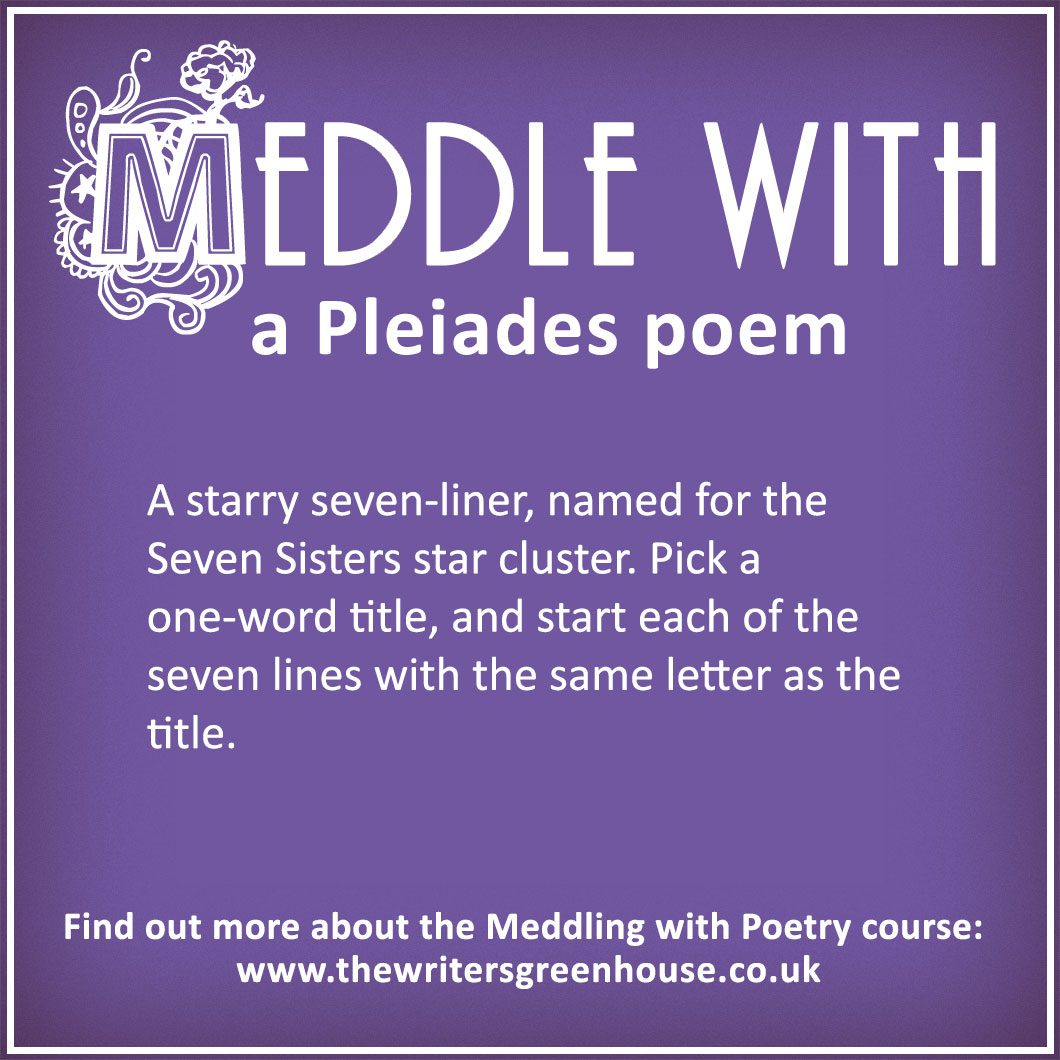
Meddle with a Pleiades poem


A starry seven-liner, named for the Seven Sisters star cluster. Pick a one-word title, and start each of the seven lines with the same letter as the title.

A simple, flexible form with a perfect touch of constraint: a one-word title, seven lines, and every line starts with the same letter as the title.

The Pleiades is the Seven Sisters star cluster, hence the restriction to seven lines, one for each sister. It's a recently invented form Craig Tigerman came up with it in 1999. (And had the wisdom not to name it the Namregit. Richard Wilbur, take note!) Hortensia Anderson then came up with another requirement: as one of the Seven Sisters is so pale that it's almost invisible, each line should be just six syllables. (She's a haiku and tanka poet, so tiny syllable restrictions are right up her street.)

I like playing with both variations. In this example, I've used the six-syllable limit:

Perpetual

Plain-song echoes in old
porous stone. Wilting weeds
plead. Thistles fly where once
prayers flew. Roof gone, sky stark,
peel back centuries: the
Passion, or passions, all
places die, immortal.


The Meddling with Poetry course explores a host of different poetry forms, as well as the musicality of language, poetic imagery, and other aspects of the poetic. Absolute beginners and experienced writers are equally welcome. You can read more details and book a place here.


Meddle with a quintilla poem


Meddle with a quintilla poem: A Spanish five-liner with plenty of rhyme. You have five lines, each with 8 syllables. Use 2 rhymes throughout, and don’t end on a rhyming couplet. That gives you lots of possible rhyme schemes: ababa, abbab, abaab, aabab, or aabba. Just don’t end aa or bb!

Another nifty quickie: just five lines, each of 8 syllables, and two rhymes throughout but you can't end on a rhyming couplet. That gives you lots of possible rhyme schemes: ababa, abbab, abaab, aabab, or aabba.

Here's a draft quintilla I wrote about the hodag, using its name as an acrostic. Merriam-Webster's lovely blog introduced me to it, and it's described as "a mythical animal reported chiefly from Wisconsin and Minnesota, noted for its ugliness, lateral horns, and hooked tail, and reputed to be outstanding in both ferocity and melancholy." This one's rhyme scheme is a b a b a.

Howls tear the trees; it lashes
out in horned despair, its tail
dragging, hooked, the sap from gashes’
aromatic pine. A trail
glistens where it slumps in ashes.

And if you put two quintillas together, you get a copla real. (Both stanzas use the same rhyme scheme.)

Off you go quintillering, copla-realing if you fancy it, and beware the ferocious, melancholic hodag and the forbidden final rhyming couplet.


The Meddling with Poetry course explores a host of different poetry forms, as well as the musicality of language, poetic imagery, and other aspects of the poetic. Absolute beginners and experienced writers are equally welcome. You can read more details and book a place here.


Meddle with a coupling poem


Like someone else’s words? Use their lines and write your own new lines in between each of theirs. You can do this with articles you’ve screengrabbed, fiction snippets, other poems, whatever you fancy.


Like someone else’s words? Use their lines and write your own new lines in between each of theirs. 

You can do this with articles you’ve screengrabbed, fiction snippets, other poems, whatever you fancy. Part of the pleasure is twisting or enriching the meaning of the original lines, playing with or against them and toying with the grammar, especially when sentences run across lines. This is a very new form, invented by Karen McCarthy Woolf.

A quick note on copyright: the person who wrote the original words owns their copyright. If you want to share your poem (online or by publishing it), you'll need to get their permission or pick words that are already out of copyright (in most countries, that means where the author has been dead for more than 70 years). Alternately, you can do a double-coupling poem: write your lines in between theirs, then remove their lines and write your own new lines between yours.

For variation, you can also try a hidden coupling poem, where you pick a poem which you haven't read and cover it with paper. Reveal the first line, copy it out, then write a line yourself, then reveal and copy out their second line, and so on. It's a thrilling way to work, not knowing what's coming next, but a word to the wise: get someone else to pick the poem for you and check its length and suitability. I chose a poem from the index of a book based on its title and that it was out of copyright – it started out well enough, and then I found myself trapped in swathes and swathes of lyrical pastoral description! By the tenth line rhaposidising about mountain scenery, while I tried to add stuff in between, I was losing the will to live.

In this example, I'd screengrabbed three quotes from an article on fugue states which had struck me deeply. The words not in italics are from "How a Young Woman Lost Her Identity" by Rachel Aviv (2 April 2018, New Yorker), reproduced with her permission.

Fugue

dissociative fugues are organised and
I can still drive, as if this metallic blue momentum were
purposeful, operating according to some
enduring physics, though even my hands have lost
internal logic. The person’s thinking is
smeared around a conversation under a tree,
dominated by a “single idea, that
escapes her fingers, trying to reach him, which
symbolizes or condenses (or both)
the event horizon around this singularity, which swallows
several important ideas and emotions,”
nimbused by bereft light particles, partnerless now. Read what
Lowenstein writes.

Furious sun fought air conditioning. I think by then I had driven
for several hours. “I had lost the ability
to park, to decide turnings, but I stopped,
to understand categories,” she said. “I
sat in a deli. I didn’t know what food I liked. I
no longer had a chronological measure
of selves – if that self had gone, the singularity had eaten all
of time. I no longer experienced myself
but thought, once, I had eaten sundried tomatoes
in a specific place. I didn’t have an
idea beyond that, but ordered some.” No-one

understood why someone might forget
her own mouth, or how to move in time, might lose
her identity during the storm. “There
I sat, immobile, with the sundried tomatoes. I knew I
was a lot of trauma,” she said softly. “It
spilled from me, in Hawking radiation. I
cracked things wide open.” A man
had vanished; this anti-particle self appeared.

If you want to give it a go, check your own screengrabs folder for inspiration (remember you'll need the other person's permission if the poem goes public) or try an out-of-copyright poem or book - here's a comprehensive list of poems in the public domain.


The Meddling with Poetry course explores a host of different poetry forms, as well as the musicality of language, poetic imagery, and other aspects of the poetic. Absolute beginners and experienced writers are equally welcome. You can read more details and book a place here.


Meddle with a fold poem


Lovely repetition and light rhyme make a flexible, flowing form: 11 lines, with all the odd lines rhyming, and the end of line 1 repeated at the end of lines 5 and 11.

A fold poem uses a bit of repetition and very light rhyme (only every second line rhymes) which makes it a wonderfully flowing form to write.

It has 11 lines, and the end of line 1 repeats as the end of lines 5 and 11. (That can be one word, a phrase, or most of the line, as you wish.) All the odd lines rhyme (1, 3, 5, 7, 9, 11) - but because 1, 5, and 11 are the same words anyway, you actually only need four rhymes total. Here's what the form looks like:

1   ~~~~~~ refrain      a
2   ~~~~~~~~~~~    *
3   ~~~~~~~~~~~    a
4   ~~~~~~~~~~~    *
5  ~~~~~~ refrain       a
6   ~~~~~~~~~~~    *
7   ~~~~~~~~~~~    a
8   ~~~~~~~~~~~    *
9   ~~~~~~~~~~~    a
10 ~~~~~~~~~~~    *
11 ~~~~~~ refrain      a

refrain is the repeated bit; a is the lines that rhyme; * means no rhyme. As with any poem that uses repeated lines, you can play with twisting the meaning, or just use it as obsessive repetition

The fold peom was invented by Gillena Cox, who also specifies that there must be a reference to nature (as with haiku) and how it affects you as the poet, moments that are "special, simple and exactly". I take that specification with a pinch of salt: I write more than enough about nature as it is and I think the form is more flexible than that.

Here's the first fold poem I wrote, about choosing a perfume. The repeated bits are underlined and the rhymes are in bold - and yes, there is an invariable reference to nature, but that's more because it's me writing than because I was obeying that requirement! Anyway, is perfume distilled and bottled still nature?

Inhale: English oak and hazlenut,
cedarwood and juniper, cedrat,
amber, oud, and bergamot – the glut
drags you, gasping, country after country,
but… English oak and hazlenut
is home. Your skin says yes and welcomes in
its pheremonal counterpart to rut
in glee upon your wrist: it knows you well,
your smell of onion, sandalwood, and slut,
your lazy warm delight, your greenish gown,
a spell of English oak and hazlenut.
Have fun folding your own poems, with absolute freedom to ignore any rules you wish!


The Meddling with Poetry course explores a host of different poetry forms, as well as the musicality of language, poetic imagery, and other aspects of the poetic. Absolute beginners and experienced writers are equally welcome. You can read more details and book a place here.


Meddle with a wreathed poem


Instead of rhyming the words at the end of the line, each end-word has a rhyme somewhere in the next line. That’s it! You can combine this with any other form of poetry as well – wreathed sonnets, wreathed golden shovels, etc.

Instead of rhyming the words at the end of the line, each end-word has a rhyme somewhere in the next line. That’s it! You can combine this with any other form of poetry as well – wreathed sonnets, wreathed golden shovels, wreathed anything really. If this is your first wreathed poem, then try it out on its own first, before combining it, or if you're combining it with another form, pick one you already know well.

In this example, the end-words rhyme as well (a b a b a b a b a b), but they don't have to. I've marked the end-words and their matching rhyme in the next line in bold colours.

The balsam bobs. The narrowboat’s paint flakes.
Blackberries glisten, where bramble snakes its way
through the hawthorn, and pray for lips. A breeze rakes
the trees’ reflections; breaking through leaves, a ray

wobbles on ripples. A spider’s ballet makes
geometry of sun and waits for prey.
The hops and hay ripen while the lakes
give up their geese. It takes its time, decay:

while leaves fray, twigs brittle, and wasps hold wakes
by drizzlelight, mud cakes the memories of May.

I've used some half-rhyme in this (makes / waits, rakes / break) and also, because the rhyming word is in the middle of a line, you don't have to rhyme the whole word, just the heavy-syllable bit (rakes / breaking).

Try it out with some free verse, enjoy the freedom it brings to rhyming, and have fun!


The Meddling with Poetry course explores a host of different poetry forms, as well as the musicality of language, poetic imagery, and other aspects of the poetic. Absolute beginners and experienced writers are equally welcome. You can read more details and book a place here.


Meddle with a triolet poem

Meddle with a triolet poem. Like your first two lines? Just keep using them!
FIRST LINE
SECOND LINE
new line, rhymes with first line
FIRST LINE
new line, rhymes with first line
new line, rhymes with second line
FIRST LINE
SECOND LINE

The triolet is a fabulously compact repeating form, where the first two lines make up most of the poem. If you've got two good opening lines, why not make the most of them?! Part of the fun, too, is seeing how much you can shift their meaning around each time they're repeated, by using words with two meanings, or with the different lines that lead in, or by punctuating them in different places. That said, the lines can also be repeated for the sheer force of repetition, the insistence of it.


FIRST LINE a
SECOND LINE b
new line, rhymes with first line a
FIRST LINE a
new line, rhymes with first line a
new line, rhymes with second line b
FIRST LINE a
SECOND LINE b

The rhyme scheme is a-b-a-a-a-b-a-b, but because of the repetition you actually only need 3 a-rhymes and 2 b-rhymes. For the metre, people often use iambic pentameter, but you don't have to. Here's an example:

At the prod of a finger, a sea anemone closes.
It can’t unfurl its tentacles till danger has passed.
It tickles so lithely at tides, one hardly supposes
at the prod of a finger, a sea anemone closes.
The rockpool is tight and clenched, where just before, roses
were laughing and loose in the water – then sealed, aghast
at the prod of a finger. A sea anemone closes:
it can’t unfurl its tentacles till danger has passed.

It's also known as a French medieval rondeau, and is part of a group of repeating forms that all have almost the same name and slightly different lengths and patterns: the rondeau, rondine, roundelay, roundel, rondeau redoublé...! So if you find repeating lines fun, there's a ton more out there to play with.


The Meddling with Poetry course explores a host of different poetry forms, as well as the musicality of language, poetic imagery, and other aspects of the poetic. Absolute beginners and experienced writers are equally welcome. You can read more details and book a place here.


Meddle with a golden shovel poem

Meddle with a golden shovel poem. Have a favourite quote or lyric? Write it down the right side of the page and use those words as the last word in each line of your poem. See where it goes – it might surprise you.

A golden shovel is a lovely form of free verse - no rhyme scheme or set metre (rhythm) and a great form when you're not sure what you want to write about or what exactly you want to say about something: the quote gives you something to riff off and explore, and the end words shape your thoughts. As you write each line towards its end word, you follow the flow and discover what you want to say. It was invented by Terrance Hay.

Here's one of my golden shovels, using a snippet from a recipe for its quote.
Always in memory yellow and blue, the drizzle
grey backdrop cropped from last year, from the
year before: always in memory sunshine pooled like oil
around our feet, while this March slides slowly
through the mud. Knocking clots of clay from boots while
staring at the dwarf hyacinths you’ll remember, whisking
aioli in a hunger for scorched days and salt to
tingle the breeze – but this March too will emulsify
in thick folds of gold, as time drips into it.


The Meddling with Poetry course explores a host of different poetry forms, as well as the musicality of language, poetic imagery, and other aspects of the poetic. Absolute beginners and experienced writers are equally welcome. You can read more details and book a place here.


Meddle with an elevenie poem

Meddle with an elevenie poem. A nifty little quickie, just 11 words total: 1 word: a noun 2 words: what it does 3 words: where it is 4 words: further explanation 1 word: a feeling about all this

The elevenie's an absolute beauty and a very handy form to have up your sleeve when you want a quickie. The form is blissfully simple and creatively constrained, so you can launch in with just your noun (that's a thing word) and discover the rest as you go, through following its strict rules. You can also write double and triple elevenies if you want, or as many as you please. Here are some of my draft elevenies:

Single elevenie

Spiderwebs
catch petals
strung in midair
elf-veils suspended, decaying
uncertainty.


Elevenie series: Colour elevenies

Clouds
bulge lavender
over slate roofs
ragged with distant rain
privately.

Beech
brittles copper
against red brick
glowing in late sun
inviting.

Featherboards
slide creamily
around the courtyard
wrapping the edges in
calm.

Willow
curls greenly
in humid stillness
every twig twisting with
delight.

Variation: for a fun / silly group game, try playing these "Consequence" style: each person writes a line, folds their paper, and passes it on. The resulting poems can end up hilarious, nonsensical, or uncannily brilliant. This was one I wrote with my nieces, Isabel (11, black pen) and Harriet (8, orange pen). Remember that we couldn't see what each other were writing!

Parrots
hover, untidily
up down everywhere
They dream of jungles
terrified


The Meddling with Poetry course explores a host of different poetry forms, as well as the musicality of language, poetic imagery, and other aspects of the poetic. Absolute beginners and experienced writers are equally welcome. You can read more details and book a place here.

Coming Next:

Summer Workshops
AUGUST 2026
OXFORD, UK

Lively one-day creative writing workshops for adults on Saturdays in August.

READ MORE AND BOOK

Meddling with Poetry
OCT–NOV 2026
Online | In person

Explore a variety of poetry possibilities in lively workshop-style classes.

BOOKINGS NOW OPEN