fiction posts
Showing posts with label fiction. Show all posts

Writing Skill: Implicit Colour

Implicit Colour

Berries in the snow.
Chocolate flecked with hazlenut.
Lavendar crowded with bumblebees.
Daisies on the lawn.

In each of those, I don't need to tell you the colours for them to leap into your mind's eye: they each create vivid colour palettes, just through the things themselves. And there are heaps of things that will do that for us.

That's what we're going to play with in this Writing Skill: making your writing burst with implicit colour. So give yourself the gift of ten minutes' writing time, grab your pen, notebook, and something to sip, and let's start.

For colour inspiration, we're using the handy resource, Hex-Hub. Originally designed to give you the hex-codes of colours for websites, it has fantastic colour names. It divides them into five palettes: neutrals, warms, greens, blues, and purples. Ignore the neutrals and just focus on the four colour palettes.

On some paper or in your notebook, devote a page to each colour palette. (If you want to keep it a ten-minuter, allow 2.5 minutes per palette as well.) Then click on a palette and scroll through the colour names, jotting down all the names of things that catch your eye. For example, under warms, I swiftly get snow, rose, salmon, coral... Make sure you only write down names of things, not fancy colour words like "azure". Go through all four colour palettes like that, gleaning things with implicit colour.

The newly heightened awareness from just doing that exercise is enough, if you're using this as a warm-up and hankering to dive back into your work-in-progress. If you want to play with it further, then I suggest writing a poem or a short passage of description inspired by your favourites things you've gleaned, letting their inherent colours fill the page without an adjective in sight.

One side note: In my examples at the top, you almost definitely saw red berries, even though berries also come in white, orange, and black. Likewise, "apples" usually suggests green, despite all the other colours available. But some imaginings will vary. I can't control whether you saw pale English lavender or deep purple French lavender. I'm more likely to picture a big white daisy with a yellow centre (the ones I grew up with) than the little white-and-pale-pink ones more common in England. I saw dark chocolate; you might have seen milk chocolate. That's okay. Part of letting things come alive in the reader's mind is giving space for them to imagine it, not controlling every! last! detail! lest they inadvertently stray from our vision. We want to give them just enough detail that the rest can come alive in their mind, not constrain them to ours.

Have fun!

Implicit Colour If you want to discover more ways to sharpen your style and lift your writing, the Hone Your Style workshop is running on Saturday 29 August 2026, in Oxford. In a fun, friendly, supportive atmosphere, you’ll explore your taste in style and how to enrich and refine that in your own writing. Read more about the workshop and book your place here.

Writing Skill: Story Pitch

Story Pitch

Writing a story pitch gives most of us a wobble. You're excited about your story, and then suddenly you have to "pitch it" to an agent or editor, and your words wither to husks. Fair enough! Doing something new is always a bit scary, a bit of a challenge. Doing something new when what's at stake is the future of your beloved story? That's terrifying!

So in this Writing Skill, we're going to practise it with non-existent stories, absolutely nothing at stake, just a lot of fun and Hollywood-Voice mimicry. Plus, I have suggestions to turn that same bold confidence to your own beloved story if you have one, and ideas of how to use this with your writing group / buddy. Give yourself the gift of ten minutes' writing time, grab your pen, notebook, and something to sip, and let's start. 

For our non-existent stories, we're going to use the handy ran-gen, Big Huge Lab's Plot List. Plot ran-gens are always useful for practising key skills when using our own story puts too much pressure on us, so this is ideal for practising story pitches. It throws out a selection of 6 randomly generated plots (NB: randomly generated, not AI-generated), which you can then play with, gleefully and carelessly, to try things out. In this case, story pitching!

First off, head to Big Huge Lab's Plot List, and from the six one-sentence plots it gives you, pick three. I chose these three:

  • A cold-blooded assassin meets a strange beggar woman on a voyage to a new land.
  • A convicted murderer comes to life in Los Angeles.
  • Hercules escapes from prison.

Next, you're going to write three quick story pitches, one for each plot: fast, bold, exaggerated, with your marketing hat on, using the Hollywood Voice for added drama and silliness. The bigger and bolder you go here, the better! Each pitch should include:

  • The main character
  • The "inciting incident" - what starts the story moving
  • The aim / goal
  • The problem / what stops them
  • A sense of the setting

The generator will give you some of those; the others you can make up. (And if you get stuck on naming the characters, remember you've got Behind the Name up your sleeve: go to Behind the Name, click your language from the home page, click "more filters", and then choose "community impression". And don't forget all these nifty links are on the Writers' Links page on my site.) So bound into your pitch, no-holds barred! Here goes... (I'm writing this at speed, no planning!):

Cold, deadly Natasha has left a discreet trail of corpses across her career, but her most challenging assignment yet sends her across the desert to a new land. When a strange beggar woman persistently haunts their caravan at every oasis, she begins to suspect she's been unmasked - but the truth may be even more terrifying.

There we have it!

  • The main character: Cold deadly Natasha, who has left a discreet trail of corpses across her career,
  • The "inciting incident" - what starts the story moving: a strange beggar woman persistently haunts their caravan at every oasis
  • The aim / goal: complete her assignment; find out what the strange beggar woman is about
  • The problem / what stops them: also the strange beggar woman
  • A sense of the setting: a desert, and far back enough that we don't have air travel

Off you go! Three big bold brave pitches! If you're keeping this a ten-minuter, give yourself three minutes for each.

If you have an existing story

Write three big bold brave pitches for the Plot Lab stories first. Then, while you're on a roll, throw your own story in the mic and give it the exact same treatment. You can always de-cheese it later: for now, full Hollywood-poster pulp-fiction stuff!

If you have a writing buddy / group

Once you've each written three pitches, swap, and each tell each other your favourite from each person's batch. Often, stuff we think is too over the top ends up being the one that works better than we expect! When you've chosen your favourites, also make notes on nifty strategies / useful turns of phrase from all the pitches.

Have fun!

Publishing If you're dreaming of getting published, it starts with this sort of thing, and sending your writing out: so that's what the Publishing workshop covers on Saturday 22 August 2026, in Oxford. Whether you write poems, stories, or both, you'll find out where to send it, sort your layout, and write synopses and cover letters. All in a fun, friendly, supportive atmosphere. Read more about the workshop and book your place here.

Writing Skill: Sound of Water

Sound of Water

When we’re dealing with writer’s block, whatever the cause, we need to start by being gentle with ourselves. List exercises and specific description are two of the gentlest ways to get our pens moving and start finding our way back to the place of ideas. They’re also both perennially useful for writing, even when we’re going great guns: lists help us cast a wider net for ideas, without pre-judging them; and we always benefit from practising description, as it’s the writing skill we use least in the rest of life.

As an added bonus, given the heatwave, this is themed around water. Writing is a joy – or at least, it’s meant to be. It’s our play space, our escape into secret worlds, and if what we need is somewhere cool and watery, we get to make that up!

So find your notebook and pen, settle yourself somewhere cool with an iced jug of something (people in cooler climes: feel free to substitute appropriately for your current weather!), and give yourself the gift of ten minutes’ writing. Or longer, if you want: this is your world.

Part One: Lists of Watery Places

You can give yourself 5–10 minutes for the list (five if you want to keep the whole thing a ten-minuter) OR you can write the numbers 1–20 down the side of a page. Some people prefer a time limit; some people find time limits stress them out and prefer a quota. You choose whatever suits you best. Then write a list of watery places. For example:

  • the sea 
  • rock pools on the Garden Coast
  • a cave with dripping water
  • that cave we visited in Greece with a lake and a boat 
  • the weir by the canal

You can be as general or as specific as you like. Don’t worry about whether ideas are "good enough" or not: the joy of a list exercise is that you put down a bunch of ideas, so they don’t all need to be good. A lot of them end up being part of our thinking – eg in my example, "the sea" was what reminded me of those specific rock pools, and caves in general reminded me of a specific cave. Everything you think of goes down on the list.

Part Two: The Sound of Water and Watery Words

Now you’ve got your list, spend the rest of the time (five minutes if you want to keep the whole thing a ten-minuter) listening to and describing the sound of water. Adding sounds always makes a story or poem much more immersive, and water is one of those things we have heaps of onomatopoeia for – ie words that sound like the actual sound, like "glug", "slosh", and "trickle". Plus water tends to be pretty ubiquitous anywhere humans settle or hang around, so having water-words in your sound repertoire is always handy!

For listening, go to MyNoise.Net: very high quality soundscapes, professionally recorded and very lovingly put together by Dr Stefane Pigeon. He’s got heaps of watery soundscapes, so use your list as inspiration for what kind of water you’d like. (I’ve been listening to Icelandic Shores all week.) Once you’ve clicked on your water soundscape, do check out the presets below it as well, to play with, and the slider animation button which varies the sound as you listen.

While you listen, describe the water. You can write full sentences or simply brainstorm words, whichever you prefer. If you want more words, look at Reverse Dictionary’s sound-of-water words for extra inspiration.

That’s it! Your list’s given you more ideas of story locations, where interesting things might happen, and you’ve expanded your description repertoire to include the often-underused sense of sound. And you’ve spent ten minutes writing. Hurrah! (How’s that jug looking? Need a top-up?)

If you’re enjoying yourself, though, and want to take it futher, here’s a serving suggestion for you:

Optional: Moving through the watery place

To play with this futher, add someone moving through the watery place: a character through whom we’ll get all the lovely description. With all your water words, as much as possible, you want to use them as nouns (thing words) and verbs (doing words) not describing words or ___ing words: that keeps the writing lively and active. So if I braintormed "sloshing" and "glugging", I can say "The waves sloshed over the sand and glugged between the rocks".

  • If you’re using this as a starting point, I suggest you write a descriptive passage / poem about exploring your watery place and moving around it: that’ll give you plenty of variety of water-sounds to describe. And have another look at those presets in MyNoise: they’ll give you a sense of moving around as the sounds change.
  • If you want to use this with your own story, I suggest you pick the places where water sounds could be prominent, and then write a passage of description for each one. You might not use that passage as-is straight in the story: you’re sharpening your awareness of what the water sounds are, and expanding your repertoire of water-words by using them. Though some snippets might go straight in!

Have fun!

Past Writer’s Block If you want to explore more ways to get from writer’s block back into your joy of writing, and ways to unpick what's causing it, the Past Writer’s Block workshop is running on Saturday 15 August 2026, in Oxford. In a fun, friendly, supportive atmosphere, you’ll identify the obstacles that keep you from the joy of writing and find ways to move past them. Read more about the workshop and book your place here.

Writing Skill: They Both Know

They Both Know

When we're writing dialogue, we want it to sound natural – but actual natural speech, in real life, is freighted down with tangents, filler words, dead-end sentences, and an astonishing amount of general burble. If you've ever transcribed real-life conversation, like I had to do at uni in Linguistics, you'll know what I'm talking about! It makes for a dreadful read. So in stories, we want to give the flavour of natural speech, without quite as much clutter. 

We also want to give a sense of the relationship between the characters: dialogue's a dynamic between people. And a sense of their individual points of view, what they know or don't about each other and what's happening, how they feel about it.

This Writing Skill is perfect for practising all of that, and you can use it with your story in progress OR with fresh characters, plus I've got a suggestion for writing groups / buddies. So give yourself the gift of ten minutes' writing time, grab your pen, notebook, and cuppa, and scribble away!

To start with, you need two people who know each other well, and are equals. They can be best friends, partners, siblings, whatever works for you. You can pick two from your story in progress, or whisk up two new characters with this quick character generator.

Something seismic has happened for Character A. How seismic you want to go depends on their age. It could be that they got / lost a job, the person they liked asked them out, they discovered their parent isn't their bio parent, they're moving city, etc.

  • If you're using your story in progress, see if you've got anything like that already to use; if not, just make up a scenario that fits them, as a way to play with their voices – you don't have to put this bit in the actual story.
  • If you're not using a work in progress, you can pick any of my suggestions above or anything else that appeals to you.

For the actual writing, assume that the reader already read the scene when the Seismic Thing happened, so there's no need to recap. Character B doesn't know it's now happened, but does already know all Character A's hopes / fears about the whole situation.

Write their dialogue / any physical reactions (eg whistling, etc) as elliptically as possible. Some possible starting lines could be…

  • "So… I got it."
  • "It's happening."
  • "She asked."
  • "It's time."
  • "They admitted it."

A tells B it's happened, but super elliptically, because B already knows so much. They're both reacting to the news / each other, they're discussing repercussions / next plans, etc. 

Some tips for writing super natural dialogue here:

  • Give as little extra explanation as humanly possible.
  • Sentence fragments are great.
  • Casual language / slang are great.
  • Opaque references are great.

Writing groups / buddies: If you want to do this exercise together, each do your own then swap. See what you can work out about what's happened without the scene before. If you're working in a group, each write down your guesses for everyone before you confer. It's always amazing to see how little exposition readers actually need!

Have fun!

Writing Dialogue If you want to explore more ways to bring your stories and your characters to life with vivid, distinctive dialogue, the Writing Dialogue workshop is running on Saturday 8 August 2026, in Oxford. You’ll explore how to make your characters’ voices distinctive and natural, give their conversations purpose in the plot, and refine the nuts ‘n bolts so the writing is easier and more elegant. All in a friendly, supportive atmosphere, with plenty of fun! Read more about the workshop and book your place here.

Writing Skill: Charming Fool

Charming Fool

A comic character, especially a central character, needs two really important features: they need to be flawed; we also need to like them. We're laughing at them, yes, but also with them, and it's affectionate, not mocking. Think of Bertie Wooster, in the Jeeves books; Sergeant Colon and Nobby Nobbs in the Pratchett books; Bridget Jones in Bridget Jones's Diary; Arthur in John Finnemore's Cabin Pressure series. This matters even if they're not the main character: we don't want our comic bits to slip over into simple nastiness: instead, we stay on the character's side, even when we're doubled over laughing at them.

So if you fancy stretching your comedic skills, to write fully funny fiction or just throw a splash of humour into your stories, this ten-minute Writing Skill will help you shape a perfect character for it. You can use it to whisk up a new character and possible story or use it with your existing story to turn a character comic.

To start off your character, pick something they think they're brilliant at: they think they're a brilliant _____, or they think they're brilliant at _____. Maybe they think they're a brilliant cook,  detective, or chess player. Maybe they think they're brilliant at understanding people, fossil hunting, or mountaineering. Spoiler: they really, really aren't. 

  • If you're inventing a character, start inventing them through this, then give them a full name, age, and a day job, to round them out a bit more in your imagination. 
  • If you're using your own story, pick a character that you'd like to make comic, and add that delusion of brilliance.

Next, based on your character's blithe delusion, pick an event to match. For example, if they think they're a brilliant detective: there's been a high-profile theft from the Ashmolean, which they're determined to solve. Whatever the matching event / challenge is, they'll set at it absolutely brimming with enthusiasm and confidence, to gleeful disaster at every stage.

A couple tips before you go further: first off, remember that we need to like them. They're deluded and confident, but not off-puttingly arrogant. Second, comedy and tragedy are a whisper apart and we want to stay on the side of comedy. That means they absolutely musn't be crushed by their failure: they remain gung-ho throughout, or at least still hugely optimistic about the next time and terribly knowing (deluded) about why this one went so badly. (This principle is called "no-harm", the same principle that slapstick uses.)

Now that you've got your character, their delusion, and the event, you can dive in! You can launch straight into the writing for ten minutes, as they cheerfully set off on their challenge OR spend ten minutes brainstorming / mapping  out the coming twists and disasters. (Some people prefer writing to discover; some prefer to plan. You do what suits you.) When ten minutes is up, you can carry on if you want or stop there, having tried out the new skill and tucked it into your repertoire.

Immersive Fiction If you want to explore more ways to be funny on the page, for full comedy or touches of humour, the Funny Fiction workshop is running on Saturday 1 August 2026, in Oxford. You’ll explore the different types of comedy, discover what tickles you most, and try out heaps of nifty techniques to sharpen and brighten your writing. All in a friendly, supportive atmosphere, with plenty of giggles! Read more about the workshop and book your place here.

Writing Skill: Social Peril

Social Peril

Social peril is a fantastic tension point in stories of all genres and styles of writing: Bridgerton-type society romance and drama, the precise contemporary observations of literary fiction, pacy commercial fiction, historical fiction from last year to the Ice Ages, fantasy and science fiction... Basically, wherever you have a society, you have the opportunity for social peril. 

It’s something that we personally feel as an intense threat, it’s about as bad as threats can get for a human, but it’s hard to explain to others why it would be so bad. It’s hard enough to explain in our own lives, even harder when the society you’re writing about is removed in time, place, or imagination, or simply in sub-culture.
   “But Mu-um, everyone will look at me!”
   “So?” says Mum.
I mean, really: what’s the worst that could happen?

Good question! Exactly the question we, as writers, need to be asking – and answering. So here’s a plotting exercise that’s great for turning internal fears and existential crises into tangible events. It’s also very helpful for creating a richer sense of society in story and for practising story shape. So give yourself the gift of 10 or 20 minutes’ writing time, grab your notebook, pen, and a cuppa, and let’s explore that.

1. Pick a society

Pick your society: Regency high society, the Stone Ages, a ship’s crew, a small English village, a secondary school, the magi in your epic fantasy, a fast-paced law firm, whatever. If you have a story in progress, you can use this to explore it. If you don’t, pick whatever tickles your fancy.

You can do the rest as a 10-minuter or a 20-minuter, as you prefer; just follow the shorter or longer time suggestions.

2. Brainstorm: what are the very real and practical ways someone relies on the group? (3 or 6 mins)

Be as specific as you can, at this point. If you’re using your own story, you’ll be drawing on the specific situtation of one of your characters. If not, let the character details emerge through the brainstorming. For example, if I chose the Stone Ages, a Stone-Age hunter needs others to hunt with, and also needs gatherers for other food, etc. 

There are a lot of ways that we formally and informally rely on each other. Brainstorm as many different things as you can.

3. Brainstorm: What are the very tangible, practical consequences of social disgrace? (3 or 6 mins)

If they’re outcast, whatever that means in your society, what happens? For example, my Stone-Age hunter can only hunt small game if they’re working on their own; they might not have access to a fire, so they’ll be eating it raw, which is more of a health risk and less nutritious; they won’t be getting the gatherers’ food, so will probably start getting scurvy, or might poison themselves gathering the wrong thing; the furs from their small game would rot because they don’t know how to handle those properly... and so on. 

Use the ideas from your first brainstorm and anything else that emerges. As you brainstorm, more details about both the character and the society will start to emerge and sharpen.

4. Turning it into story (rest of the time: 4 or 8 mins)

Now you know exactly what’s the worst that can happen, it’s time to whisk all that together into story, with five questions:

  1. What could cause social disgrace? (eg in my Stone-Age society, that might be stealing food, killing a pregnant animal, etc.)
  2. Who specifically would turn against them? This needs to be the majority, but think of some specific influential people, to show it happening. (If you’re making this all up as you go, you can just jot bare details, eg “tribe leader”.)
  3. How might you stage out the disastrous consequences? You don’t want all the bad things to happen at once, so arrange them in order of what happens. (You can just number your brainstorm in order of size of disaster / logical order)
  4. Who might stay on their side, even a bit? This is definitely a minority, and they might not be able to speak out, but they do care. Think of one to three specific individuals.
  5. What could restore their name? 

Et voilà! Social peril, that so-human but so amorphous fear, is turned into stuff that happens. Which is exactly what we want to do, as storytellers.

The Writers' Greenhouse CommunityWant more Writing Skills? As a member of The Writers' Greenhouse Community, you'll get a new Writing Skill every week: quick fun activities to develop your writing across plot, character, description, style, genres, and poems.

Plus you'll get expert advice on tap, a friendly supportive writing community, and help sending your writing out.

Find out more and join here.  

Writing Skill: Bringing It All to Life

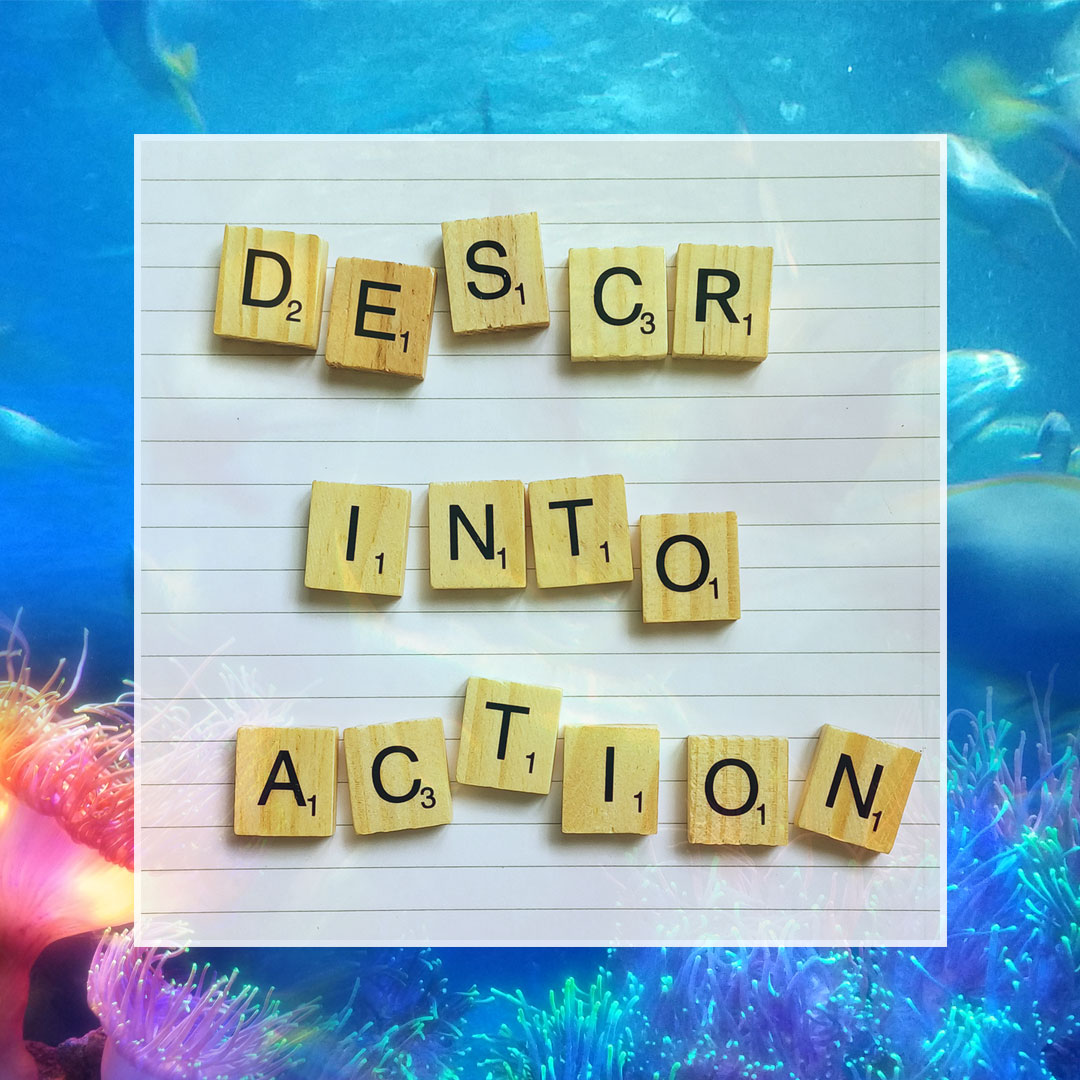
Description Into Action

The four key elements that bring a story to life, as something readers can lose themselves in and feel like they're living inside, are rich characterisation, purposeful description, a compelling plot, and live action on the page, telling the story through scenes, not explanation / exposition / etc. All of those are things we can work on individually, as we develop and draft our stories. In the final draft, they all weave together – and that's what you'll play with in this Writing Skill.

You can keep this to ten minutes, as a quick exercise to stretch those skills, or spend longer on it, as you prefer. And you can use it as a starting point for invention, if you don't have a story on the go, or try it with an existing story. Whatever you choose, grab yourself a cuppa, a notebook and pen if you can write by hand, and settle in for some fun!

Start with character description 

We're using character to start with, here, so first off we want a paragraph of description about a character: their hairstyle, accessories, clothes, habitual expression, etc. Feel free to include their habits as well. As much as possible, we want things they choose about themselves: that tells us something about their character, whereas their height / eye colour / natural hair colour / etc gives us nothing about their personality.

Here's an example from my freewriting:

He keeps a wool hat pushed down on his head in all weathers, he shuffles and slouches along in a big old coat that hangs down to his hips, and he sees the world a different shape to most folk.
    When that oversized coat came down to his ankles, its capacious pockets held the purses he lifted. Now it holds scraps of paper and pencil stubs, and if you emptied them all out and lined up the phrases, why, it would read just like that poetry they make so much of at the uni.
 

If you're using this skill as your starting point

First off, write that paragraph of description about a character, making up the details as you go along, focusing on the things they choose about themselves. Allow yourself to invent freely and wildly, with whatever comes to mind. If you want a starting point to invent your character, use this lovely quick cameo character generator. Spend five minutes on this if you want to keep it to a ten-minuter.

If you're using your own story

Flip through your writing for any static descriptions of your characters. If you have any, use one of those. If you have no static descriptions, check if you have any description at all of your characters: do you give the reader any visual hooks for them? If not, write a paragraph of how you imagine one of your characters, focusing on the things they choose about themselves. Spend five minutes on this if you want to keep it to a ten-minuter.

Turning the description into action

That paragraph gives us description and characterisation woven together already. Now we want to plait that into action, as part of a compelling plot. Quickly jot down:

  • Where is your character?
  • What are they doing and why does it matter? 

If you're using this Writing Skill as a starting point, you can just make those up. If you want some extra inspiration, try this quick plot generator and just click on "Setting" and "Situation". If you're using your existing story, look for the first scene that really features that character.

Then, for the rest of the time you have available, rewrite the paragraph, only mentioning what the character does with all those aspects of their appearance. Something can only be mentioned if they interact with it to some purpose (so not idly lifting and putting stuff back down).

Here's an example of my own reworking:

Description through action

  • Where is my character? On a rooftop, at night.
  • What are they doing and why does it matter? Spying / eavesdropping on a meeting for the head of the guard.

The next night, he had a new spot: perched on a narrow roof ledge above the curtained window, the bone flag tickling his very toes. He watched the moon scud through the clouds with a faraway gaze as if he were only trying to see the sailor who poles it across the skies. But he pushed his habitual woolly hat up above his ears and strained for three things: how many voices were in the room; whether any could be identified; and whether their words could be discerned.
    In time, he reached into his raggedy oversized coat and pulled out a scrap of paper, an old label from one of Culpeper’s bottles. It bore the solemn injunction to ‘inhale thrice daily but not to drink thereof’. He turned it over, sucked his pencil stub thoughtfully, and wrote by moonlight, ‘A hand of voices turns to fists.‘ He pushed the paper back into his pocket and continued to stare at the moon. The head of the guard would understand its meaning.

All of the detail comes to life, when it's being used as part of the action. And how much more fun, to read one of his mysterious notes, than just to be told that they read like university-admired poetry?! As you can see, I didn't fit in his childhood history: that's fine, we can't ram everything into one scene. We dripfeed info across a story.

So now, decide where your character is, what they're doing, and why it matters. Then write them in that place, doing that thing, weaving in as much of the descriptive detail as you can.

Have fun with it!

The Writers' Greenhouse CommunityWant more Writing Skills? As a member of The Writers' Greenhouse Community, you'll get a new Writing Skill every week: quick fun activities to develop your writing across plot, character, description, style, genres, and poems.

Plus you'll get expert advice on tap, a friendly supportive writing community, and help sending your writing out.

Find out more and join here.  

Writing Skill: Ideas Into Scenes

Ideas Into Scenes

Often in the early stages and first-draft, we have reams of exciting ideas in our writing, but not so much stuff actually happening on the page. We have swathes of exposition, backstory, info-dumps, and zoomed-out storytelling. That's fine: that's how we capture ideas, in first draft.  

But things actually happening, in close-up, in "real time", is what makes stories come alive. So when we rework our first draft, we want to turn all those ideas into Stuff That Happens, in scenes. In this Writing Skill, you're going to play with exactly that: turning ideas into the stuff of story. With options to use this as a starting point, OR with your existing story if you have one. You can do this as a ten-minuter, to try out the principles, or spend longer on it, as you prefer.

First up: an all-important definition.

SCENE: A scene is a section of story where things happen in close-up, in continuous time. It’s often in a single setting (but if the characters move somewhere else in continuous time, it’s still one scene). It usually includes action, dialogue, description, and sometimes character's thoughts.

To practise this, we're using the Random Plot Generator. (NB: That's a generator drawing from a database, not AI.) Click the "Situation" button to get a random situation. (You can add the other things as well, if you want more ideas.) The situation I got is "Someone is leaving prison after 20 years." So, that's my idea. Now I want SCENES.

  1. Anything we need to know or understand the situation: make that a scene.
  2. The thing is happening: make that a scene.
  3. What happens after / as a result: make that a scene.

For example:

  1. We need to know my character's been in prison for 20 years. So I'll have a scene of them giving a new inmate a tour around the prison.
  2. The thing is happening: I'll have a scene of them actually being released.
  3. What happens after: I'll have a scene of them sitting with family, maybe struggling to reintegrate.

For each of your three scenes, brainstorm

  • Action: What are they physically doing? If this were filmed, what would you see them doing?
  • Dialogue: Who's talking? What are they talking about?
  • Description: What's around them? What are they noticing / interacting with? What does stuff look, smell, feel, sound like? How does that add to the scene?

For example, in my first scene, my character is moving from room to room through the prison (I'm assuming they can roam a bit during the day in rec rooms, work rooms, etc) pointing things out. So that's their action. The dialogue is them explaning stuff to the newbie, all of which indicates how long they've been there. "Yeah, that telly broke back in 2011," etc. Description: What they'd notice about the prison, having been there so long, is the changes to stuff, and maybe see some things through fresh eyes, because they're touring people round. The description could also contribute a sense of confinement, as well as familiarity, and set the atmosphere.

Importantly, at no point am I having my character say "I've been here twenty years." That's a) as part of the discipline for this exercise: characters telling each other information is still exposition, and b) to make it more memorable. Readers aren't memorising, so one line might fly over their heads, even if I did include it. If it's important for the reader to know it's been twenty years, I want to create a sense of all that time.

If you’re using this Skill as your starting point

Pick your situation, any other details you want from the generator, and spend ten minutes brainstorming your scene(s)' detail. If you want to spend longer on it, go ahead and write the scenes.

If you’re using your own story

I suggest you do this with the generator first, as a ten-minute exercise, just the brainstorming and mapping-out parts, not the actual writing. You can then apply the same principles to your own story, for any ideas that aren't being acted out in scenes yet.

Scene 1, giving us the info we need to understand, can often be layer into an existing prior scene, rather than have a whole scene just for one snippet of info. That said, if your draft currently has more ideas than events, go ahead and make it a whole scene. 

Either way

Have fun brainstorming / scene-mapping, and happy writing! 

The Writers' Greenhouse CommunityWant more Writing Skills? As a member of The Writers' Greenhouse Community, you'll get a new Writing Skill every week: quick fun activities to develop your writing across plot, character, description, style, genres, and poems.

Plus you'll get expert advice on tap, a friendly supportive writing community, and help sending your writing out.

Find out more and join here.  

Writing Skill: Fairytale Detective

Fairytale Detective

If you want to explore red herrings, to keep the reader distracted from the true reveal you’re actually working towards, I’ve got a lovely playful Writing Skill for you: Fairytale Detective! Red herrings are always a skill worth exercising, whether or not you’re writing detective / mystery fiction, as you never want the reader to see the real ending coming.

So give yourself the gift of ten minutes writing time, curl up with your notebook, pen, and a cuppa, and have fun!

To start, pick a fairytale. If your memory of fairytales needs refreshing, here’s a lovely site which gives you heaps at a glance. And then, as this is detective fiction, you need to pick someone who’s been killed – a main character, ideally, if not the main character.

Next, choose your detective. This can be someone from within the same fairytale or you can borrow someone from another fairytale: the gingerbread man perhaps, or Rumplestiltskin, or the Beast, whoever you fancy.

Now that you’re prepped, you’re onto the main bit: assemble the cast of everyone else in the fairytale, and work out everyone’s motivations to murder the dead character! Only one of them will have actually done it (or more, if they’ve been acting in cahoots) but all of them need an apparent motivation.

You can do this planning-style, if you’re planning-inclined, or just start freewriting to discover. As for tone – you can keep it super-playful / po-faced tongue in cheek, but there is also room to go seriously dark here, in a Gothy/noir way. Think of Angela Carter’s Bloody Chamber stories and how richly literarily dark some of those are.

The main thing here is to practise exploring everyone’s motivations, so once you’ve done that, you’re done! You’ve stretched that skill. But you can absolutely take this further, if you’d like to. Here’s some suggestions of what you could write:

  • The dialogue from the interviews your detective holds with each suspect
  • Character cameos of each suspect plus description of how they present themselves
  • Action snippets of the suspects doing suspicious things
  • Action of how the detective investigates each suspect
  • All four together, writing the full story!

Have fun!

The Writers' Greenhouse CommunityWant more Writing Skills? As a member of The Writers' Greenhouse Community, you'll get a new Writing Skill every week: quick fun activities to develop your writing across plot, character, description, style, genres, and poems.

Plus you'll get expert advice on tap, a friendly supportive writing community, and help sending your writing out.

Find out more and join here.  


What Is Narrative Tension?

What Is Narrative Tension?

We’re all told that a story needs “narrative tension”, a “central conflict”, and that’s true. The problem, though, is that in this context, “tension” and “conflict” don’t mean what they usually do – so when people apply that advice, it can end up ruining the story.

The most striking example I’ve ever found of this was a “castle” – I shan’t name it, to protect the innocently hapless. We’d chosen it for a mini-adventure visit mostly because it promised Talking Portraits. After the wonderful storytelling on HMS Victory, in Portsmouth Historic Dockyard, we were all up for audio story tours!

The “portraits” were large vertical flat screens, with characters posed as paintings which then come alive and chat to you – basically videos that start moving when you enter the room. The characters were the castle’s owner, his wife, and their daughter, discussing the history of the castle. It started off fine, if a little dull… And then the characters started to argue. Mostly the couple berating their poor daughter, but sometimes they quarrelled with each other, too.

It fast became clear that someone had told the script writer that the story needed some tension, some conflict – and they’d gone for the garden-variety, not the narrative sort. Straight-up interpersonal tension and conflict.

The result? Cringing visitors were chased from room to room by this bickering family, flattening themselves on the furthermost walls to avoid setting the portraits off, warning each other on the sill of each room. Nobody wanted to witness the endless family quarrel, however many titbits of Useful History it included! Rather than giving the story energy, the tension and conflict ruined it, and we all scuttled away, dismayed.

I often see the same thing in early drafts, when people want to create narrative tension but end up with characters bickering. That makes us want to read it less, not more. It also often makes the main character less sympathetic – after all, they’re constantly sniping at people. That in turn makes us care less about their aims, which in turn makes us less interested in whether they do the thing or not. In short, it undermines the exact narrative tension which it’s trying to create.

That’s because narrative tension and conflict are not tension and conflict by our usual definition of the words: they’re much wider. In fact, I’ve stopped using the words “tension” and “conflict” in much of my teaching, and instead talk about narrative drive and interest. In the Story Elements course, we open it up to discussion of all the things it can mean, such as…

Word cloud: a false dawn, a ticking clock, aim, an arrow pointing forwards, anticipation, but then, conflict, curiosity, da da DAAA!, danger, eagerness, excitement, friction, goal, hope, impending disaster, interest, obstacle to a goal, obstacles, opposition, problems, sexual tension, suspense, tension, the narrative thread, what next, what the reader fears will happen, what the reader hopes will happen, what the reader wants to happen, what the reader wants to know, yearning

Casting a wide net of all the different kinds of narrative interest gives us a much richer repertoire to draw on, so we’re far less likely to fall into the bickering-characters trap.

It’s much more than those individual various drives, though: it’s the thread that draws the reader eagerly through the whole story. So the most helpful way to distil it, I find, is this: What does the reader hope / fear / think will happen next or want to find out?

That question is so useful that I’ve now added it to my template for my writing-group-instalments, so I always remember to ask them. And asking it sharpens my storytelling immeasurably. We always want the reader to be able to answer that question, 100% clearly: there is a definite reason they’re reading on. And if the reader can’t answer that question, we need to make the reason clearer – or, sometimes, invent it!

In each scene, in each chapter, in each act of the story, ask yourself, “What should the reader hope / fear / think will happen next or want to find out?” That’s your narrative tension, your narrative drive.


Narrative Drive Plot Tension Map

If you’d like to work on your narrative drive and plot interest in your stories, I have a brace of resources for you, now available as any-time Evergreen Resources: Narrative Drive and Plot Tension Map

With Narrative Drive, you’ll distil that all important question for a story, including the crucial component of backing the character through the story. With Plot Tension Map, you’ll pace and layer that across the whole story, so every part is equally gripping: no slow starts or soggy middles.

Both are self-paced videos that you can use any time, taking you through the process in an hour. You can use them to plan a story, troubleshoot it, or redraft it, whichever stage you’re at. Click here to get started with your Narrative Drive.

Writing Skill: Surprising Fact

Surprising Fact

Creativity loves novelty, the element of surprise, and what could be more novel and surprising than those lists of Surprising Facts that do the rounds? They're always tempting to scroll, but somehow we end up just threading them through our eyeballs, then forgetting them. Creativity 0, Ennui 1. It's definitely not generating the inspiration we want. 

But those surprising facts can take on exciting life and spark creativity. A couple of years ago, one Sunday morning, I was putting away the supermarket delivery with Radio 4 on in the background. It was Sunday Worship; I was about to change stations, but the priest's Scottish accent, his voice, and the music were so lovely that I left it on. At one point, he started speaking about seals and said, memorably, "They always come if you sing." 

The Story Elements class had just come up with a story about seelies, so immediately my mind leapt with the fact. I should tell them that, I thought. And what a beautiful overlap between seals and mermaids, which seelies are halfway between, that they come if you sing. And weren't tales of mermaids sometimes attributed to a particular type of seal that looks extraordinarily human? And how could that be used in the story...? 

As soon as there's a story for a fact to land in, it comes alive. But sometimes we need to find a story, and we can't always rely on life and random Radio-4-listening to hand us exciting facts: we need to seek them and make stories from them. Through that, we sensitise ourselves more to noticing them. Then, even if the particular facts we seek out and take for a tiny story-spin go nowhere, we're honing our alertness for other surprising facts, sources of stimulus, creative food. 

So for this Writing Skill, the idea is not just to read through surprising facts, like munching popcorn, but to pick a few that you can really imagine and integrate. The fact itself is just the spur for creativity: the creative boost comes when we use it.

To find your surprising facts, here's a really lovely list of genuinely delightful information. It's helpfully arranged into categories: Animals, History, Travel, Music, Sports, Human, Funny, and Miscellaneous. You can pick your favourite category or choose a cross-section. However you approach it, pick three facts and write them down.

Then, for each of your three, write one of these, whichever suits the fact or you best:

  • A brief snippet of it happening, like an excerpt from a story or a scene
  • A 2-3 line story teaser or blurb (think Dramatic Hollywood Voice)
  • A tiny poem – perhaps an elevenie?

And just as the surprising facts come alive when you use them, so do the Writing Skills. So give yourself the gift of ten minutes, curl up with a cuppa, your notebook, and a pen, and take three facts for a quick writerly whirl. 

Have fun with your facts, and enjoy the week ahead of increased alertness and creative sparkles!

The Writers' Greenhouse CommunityWant more Writing Skills? As a member of The Writers' Greenhouse Community, you'll get a new Writing Skill every week: quick fun activities to develop your writing across plot, character, description, style, genres, and poems.

Plus you'll get expert advice on tap, a friendly supportive writing community, and help sending your writing out.

Find out more and join here.  

Writing Skill: Unjudge

Unjudge

Creating and getting to know our characters is one of the most joyous parts of writing. It's also an area where we easily slip into habits or rut, without realising. This Writing Skill, UNJUDGE, is a lovely character-creation tool for developing more unexpected characters in a way that ducks around our habitual thinking. So give yourself the gift of 10–20 minutes writing time, grab your notebook, pen, and a cuppa, and curl up somewhere comfy.

For this skill, you'll use the site This Person Does Not Exist. It's an AI-generator that creates wholly convincing photos of people who – like it says – don't exist. Though they really, really look like they do! Each time you press refresh a completely new image is created. So the first thing you're going to do is choose your character. Remember, refresh means it creates a new image: you can't go back to a previous one! So I suggest you allow yourself a maximum of 3 "refreshes", to choose your character, and make sure you screengrab each one, cos once it's gone, that's it.

Important note for screengrabbing on a computer: If you right-click and say "copy image", it doesn't copy the image you're looking at! It generates a new one and copies that. To save the picture you're looking at, use the Prt Sc (print-screen) button and then paste it into a document. You can also use a screen-snip tool.

Part One

Once you've chosen your character, study their face and spend half your time (five minutes, if you want to keep this a ten-minuter) making up what they're like: their personality, their job, their hobbies, their relationships, whatever comes to mind. Go completely with whatever comes to mind; don't worry if it seems an obvious choice, a bit cliched, even a bit judgy. It'll be fine, trust me.

I suggest you don't scroll down to Part Two until you've done that bit. 

Collage of characters from Renaissance drawings and a mannequin

Part Two

Now that you've got your character fully described, generate ONE more "photograph" by refreshing the site. That's the person you've actually been inventing! Everything you've just made up gets reassigned to the new face. Make sure you screengrab your new character, then spend a couple minutes more making up additional details. The only catch is: you can't change any of the details you've already made up.

When we're working on our own from a photo, it's often easy to slip into rather judgy and prejudiced character creation. We can fight like crazy against our own biases, but that often means we're spending most of our creative energy on batting away the biased choices, or making the exact opposite choice instead. By doing a switcheroo with the photo instead, none of those judgements came from the person's face, and the new identity is often an unexpected fit for our inventions. The disjuncture also leads to fresh ideas.


The Writers' Greenhouse CommunityWant more Writing Skills? As a member of The Writers' Greenhouse Community, you'll get a new Writing Skill every week: quick fun activities to develop your writing across plot, character, description, style, genres, and poems.

Plus you'll get expert advice on tap, a friendly supportive writing community, and help sending your writing out.

Find out more and join here.  
Writing Skill: Magic Power Backfires


Magical Power Backfires

Magic is a joyous aspect of fantasy, but without limits, magic will scupper your plot or leave giant plot loopholes. Some ways of restricting magic are that it’s…

  • addictive
  • drains the person using it
  • creates an imbalance
  • built-in limits of the aid (eg potions)
  • dangerous for the world or the user
  • comes at a cost
  • the resources to make it are limited

Having the magical power backfire, though, creates a lovely new dimension to it, following law of unintended consequences. This Writing Skill gives you a lighthearted way to play with it, to explore the story possibilities it opens up. I suggest you spend 10–20 minutes on it, whichever suits. Grab your notebook, pen, and a cuppa, and curl up somewhere comfy.

If you’re using this Skill as your starting point

What superpower or magical power have you always really wanted? (For me, that's breathing underwater or flying.) You're going to give someone that magic power – and then explore all the ways it backfires and all the problems it creates.

If you’re using your own story with magic in it

Pick any magic that appears in your story.

Once you've got your magic

That power might seem like such a wonderful thing to have, but it's going to backfire, in all sorts of unexpected ways. For the user, for those around them, in other ways... 

I suggest you do this as a freewriting exercise, to explore all the ways it goes wrong. Freewriting means writing continuously and completely non-judgementally, without caring about good / bad ideas, grammar, non-sequiturs. Write anything that comes into your head; just keep writing. Follow it and see where it goes. You’re creating raw material, like weaving cloth which you can later cut up and sew together.

That freewriting might include talking out loud to yourself on paper, writing snippets of dialogue or description, summarising events, dipping into storytelling whatever comes out of your pen.

Allow yourself to discover, and have fun!

The skills you're developing

Freewriting: Freewriting is a wonderful way to create raw material, to develop and explore ideas you might otherwise cut back earlier, and to discover voices and subject matter you would never have consciously planned. It could turn into any of the different kinds of writing. Equally valid and valuable, it could simply be the beautiful art of forming sentences on paper, or an exercise in writing more freely – a freedom you can carry into your other writing.

Constraining magic: As I said at the start, we always need to constrain magic, in fantasy, so it doesn't ruin the plot. Using the magic's own inherent properties is an especially satisfying and uncontrived way to do that.


The Writers' Greenhouse CommunityWant more Writing Skills? As a member of The Writers' Greenhouse Community, you'll get a new Writing Skill every week: quick fun activities to develop your writing across plot, character, description, style, genres, and poems.

Plus you'll get expert advice on tap, a friendly supportive writing community, and help sending your writing out.

Find out more and join here.  

Writing Skill: Soundscape Sliders


Soundscape Sliders

My two favourite soundscape sites for writing, MyNoise and Ambient Mixer, both create soundscapes of different places and situations by mixing a bundle of different sounds. Each sound has its own slider, and the listener can play with the sliders to adjust it. For instance, MyNoise's "Medieval Village" has ten sliders: Watermill, Pastoral (birdsong and brook), Rejoicing bells, Fire bell, Trotting horse, Carriages, Market, Animals, Blacksmith, and Fanfare. Ambient Mixer's "Victorian London" has eight: Colombia Road Flower Market, Horse Whinny, Church Bells, Pre Thunderstorm, Steam Train, Rain on Umbrella, Rain on Cement, and Carriages at Night.

This Writing Skill uses that idea for a lovely exploration of sounds in your writing. I suggest you spend 10–20 minutes on it, whichever suits. Grab your notebook, pen, and a cuppa, curl up somewhere comfy, and have fun!

If you’re using this Skill as your starting point

Pick a genre you like, any genre: cosy detective fiction, romantasy, Gothic, historical, space opera, near-future science fiction, epic fantasy, mythology, paranormal fantasy, dystopia, alternate history, folklore, steampunk, urban paranormal, or anything else you fancy.

Each of the genres in that list will create its own sense of place and the sounds you might expect. For example, if you choose mythology and go for Viking mythology, then your sense of place might be on a longboat or a coastal village in Scandinavia. If you choose folklore, you're likely looking at an old-fashioned rural village or farm. If you choose cosy detective fiction, that's likely to be an English village (but it could also be a Caribbean island). If you choose steampunk, that's definitely Victorian era, but it doesn't have to be London; it could be anywhere you choose. If you choose urban paranormal, then what urban spot are you picking: Oxford? Cheltenham? Croyden? So pick your genre and let that dictate what kind of place you're imagining.

If you’re using your own story

Use the main setting in that. If your characters move around a lot, pick the area you'll be using the most, or one that you want to imagine in more detail.

Once you have your place

You're going to plan a soundscape for it, featuring ten sliders. What key ten sounds would you pick out to create the complete atmosphere of being there? Brainstorm all the possible sounds you could include. If you want more ideas, spend 5 mins or so browsing MyNoise or Ambient-Mixer. (If you've come on any of the courses recently, I'll have sent you soundscapes each week, to look back at.) Save the rest of your time for inventing your own soundscape, though.

Already, that will have given you a much more heightened awareness of sounds, to include in your writing. If you want to play with it more, I have two suggestions:

  • Actually make your soundscape in Ambient Mixer! Here's the details on how. It's limited to eight channels, so you'll need to pick your top eight out of your ten. If you make one, do share it in the comments. Massive bonus here if you have an ongoing project: you can enter the sound of your world, using your own soundscape, any time you're writing. It's a time-consuming adventure, mind, so only choose this option if you're looking to fritter away several hours!
  • Write a sound description of your place: a good ten minutes' or so writing, so you really stretch your writing legs with it, giving us everything in terms of the sounds it makes and exploring your sound vocabulary.
Have fun!

The skills you're developing

Part of the joy of stories, for both readers and writers, is imagining ourselves into different places and times. That's especially true of the genres I listed: the sense of place is central to the story. That full-body immersion works best when you give readers all the details their bodies need: not just the sights, but the sounds, smells, tastes, and sensations. It's easy to forget the non-visual senses when we're writing, though. With sounds, we're often pleased if we can muster up one or two to mention. Soundscapes are a wonderful way to remind ourselves just how rich and varied the landscape of sound actually is and how many different things we're hearing at any one time.

The Writers' Greenhouse CommunityWant more Writing Skills? As a member of The Writers' Greenhouse Community, you'll get a new Writing Skill every week: quick fun activities to develop your writing across plot, character, description, style, genres, and poems.

Plus you'll get expert advice on tap, a friendly supportive writing community, and help sending your writing out.

Find out more and join here.  


Writing Skill: The Market


The Market

Markets and their ilk are a lovely moment in writing: a rich opportunity for description and world-building, filled with sensory potential. The only hitch is that as you cheerfully launch your character into this wealth of stuff, you suddenly have to invent all the stuff! Your writing flow suddenly grinds to a halt as you start googling "types of fish" or "ornamental stuff" or "tropical fruit"... Enter Reverse Dictionary.

Reverse Dictionary gives you words that use a word or phrase in their definition. For example, if you look up "ornamental", you won't get synonyms (decorative, showy, etc) but a list of ornamental things: lampshades, figurines, beading, doilies, etc. It also works well with phrases, eg "tropical fruit" brings up heaps of names of tropical fruit. If you struggle to get the exact slew of results you're after, think of one example of what you want (eg "figurine") and put that into an actual dictionary, eg dictionary.com. Look at the definition for a key word, then plug that into the Reverse Dictionary.

This Writing Skill gives you a lovely way to play with this, and hugely enrich your writing. I suggest you spend 10–20 minutes on it, whichever suits. Grab your notebook, pen, and a cuppa, curl up somewhere comfy, and have fun!

  • If you’re using this Skill as your starting point, pick any time or place setting you like – historical, contemporary, your country, another country, somewhere completely imaginary, whatever appeals.
  • If you’re using your own story, use your own time and place setting, or your own imaginary world.

Spend a few minutes brainstorming the categories of things they'll sell there. For my imaginary world, that's fish, fruit and veg, fowl, spices, and assorted snacks. For a realist story in my home town, I'd also have clothes stalls, knickknacks, second-hand books, and so forth.

Next, spend the rest of the time using Reverse Dictionary to look up types of that thing, and jotting down the examples which catch your eye.

That's it! A brief but thorough trial-run of the Reverse Dictionary, and a much expanded sense of a story's world. To take it further, launch into some writing: have a character enter the market and encounter all these stalls and things, including as many senses as you can.

The skills you're developing

Specificity: Moving from generalities and categories (eg ornaments) to specific detail creates a much richer sense of your story: the details are what bring it alive for the reader.

Sensory description: Markets are inherently multisensory: visually busy, noisy, and an opportunity to include tastes and smells, which are often harder to weave in. This makes the story far more immersive to read.

World-building: Markets are a fantastic chance to showcase your story's world in all its richness and idiosyncrasy, especially if it's a world your readers are unfamiliar with: a foreign country; a historical setting; an imaginary fantasy or science-fiction world. Spending time delving into everything it contains will also enrich your world beyond the market square: next time someone's munching on street-food, buying another character a present, or preparing dinner, you have a much wider repertoire to draw on.


The Writers' Greenhouse CommunityWant more Writing Skills? As a member of The Writers' Greenhouse Community, you'll get a new Writing Skill every week: quick fun activities to develop your writing across plot, character, description, style, genres, and poems.

Plus you'll get expert advice on tap, a friendly supportive writing community, and help sending your writing out.

Find out more and join here.  

Writing Skill: Sexy Letter


Sexy Letter: Sexy Scenes Writing Skill

Sex scenes and sexy snippets aren't just the realm of bonk-busters, Soho bookshops, hide-from-my-history sub-reddits, and excitable fan-fic: heaps of mainstream and literary fiction includes sex, often very explicitly, for excellent reasons. Sex matters in characters' lives. It can change their lives, reshape the plot, even play a role in the revolution. Three of the most mainstream / classic / Respectable novels we'll look at in the workshop are AS Byatt's Possession, Margaret Atwood's Handmaid's Tale (the positive consensual sex scene in that, not the awful "ceremony"), and George Orwell's 1984. They include the sex scenes because they matter. They also include the sex scenes because the authors knew that it mattered and included what was right for the story, instead of stopping where embarrassment dictated or vocabulary failed.

It's worth expanding your writing repertoire to include the sex scenes. It's also extremely fun. And here's an especially fun, freeing way to get started.

One character is writing a sexy letter to another character. A very sexy letter. The character writing may or may not intend to send the letter. They might change their mind while writing it, perhaps even several times. It can be a confessional letter in a newly blossoming relationship, or writing within an established relationship. But it is very definitely a sexy letter.

So who are the characters? 

  • If you have a story in progress, you can use your existing characters, if it suits them. 
  • If you've done any of the other writing skills, you can use the characters from those. Most recently, we've had two skills focused on romantic relationships: Deluded Diary, for exploring new love, and Prove It's You, for exploring established love.
  • If you don't have any characters from your work or previous skills, you could jump into either of the two above, spend ten minutes on that to discover the characters, and then come back to this.
  • If you'd rather dive straight into writing a sexy letter, you can use this quick character gen to whisk up two characters. (Feel free to adjust the ages!)

Then decide which character is writing the letter to the other, grab some pen and paper, and start writing the letter, detailing – in plenty of detail! – exactly what they're imagining, remembering, longing for, hoping, fantasising, fixating on... Remember: they might not send the letter. So they can say whatever they want. (And you don't have to show what you write to anyone. So you can have them say whatever you want.) Give yourself permission to enjoy it, to get hot under the collar, even to giggle in shock at yourself. And have fun!

This is a delightful way to approach writing sex scenes or sexy snippets, because the nature of a letter means that you're focusing on the desire, not the instruction-manual mechanics. It's the desire that makes a scene zing – which is not to say keep it abstract, desire is wonderfully specific, just trust that the form of letter-writing will take it in the right direction. Plus, it's the character writing all this, not you, so through their (eager, ardent) voice, you can find the freedom to say all sorts of things that you might hesistate to write in your own voice.


The Writers' Greenhouse CommunityWant more Writing Skills? As a member of The Writers' Greenhouse Community, you'll get a new Writing Skill every week: quick fun activities to develop your writing across plot, character, description, style, genres, and poems.

Plus you'll get expert advice on tap, a friendly supportive writing community, and help sending your writing out.

Find out more and join here.  

Word Count Is Like Paint


Word Count Is Like Paint: Text overlays a photo of well-used paint tools neatly laid out on a transparent paint sheet over a pale wooden fllor

Say a novel is 90,000 words and you have three writing evenings a fortnight. Two of those fortnights you’re on holiday, so call it 24 fortnights a year. That gives you 72 writing evenings a year. So to write the novel in a year, you need to write 1250 words every writing evening. Cool. Sounds doable. Let’s g–

HOLD IT RIGHT THERE. Word count is like paint.

This September, Will and I set about repainting the living room. We knew the size of the walls, and they all needed to be covered in paint, so measuring our progress in inches of paint would be reasonable, right? Our 30 square meters worked out as 46,500 inches of paint. We wanted to finish it in two days, so call each day eight hours, so we’d each need to paint 1,453 inches an hour. Cool. Sounds doable. Let’s go.

Will, wielding the roller, had a great painting day! He did loads! Me, going around with the cutting-in brush – I didn’t do nearly so well. Very few inches indeed. I guess I’m just a slower painter.

That was the afternoon, though. Actually, we both had a terrible painting morning. We were vacuuming walls, sugar soaping, dusting behind radiators, moving furniture, laying paint sheets – classic PAB (Painting Avoiding Behaviour) amiright? Not an inch of paint applied. Disaster.

Yeah, yeah, without that, we’d get paint clagging up with invisible spider webs and dust bunnies, paint peeling where there were grease marks, paint spattered on the sofa and floor, yadda yadda yadda… Pfft. Just excuses. Just putting off getting started. Painting nerves, right?

The next day, sadly, when we moved onto painting the skirting boards, dado rail, and cornices, Will’s painting streak evaporated. He actually did even fewer inches than me. While I got on with the business of getting paint on surfaces, you know, actually painting, he procrastinated, faffing about with “caulking” then “letting it dry”, he was “rehanging curtains”, “rehanging paintings”, “taking up paint sheets”, “carrying furniture”, “cleaning the roller”… He probably had some kind of Painter’s Block, right?

Obviously, this is absurd. The prep is essential. Clean-up is essential. Painting with a roller (province of Will’s long reach) is wildly different to cutting in edges and trimmings (province of my steady hand). Will’s expertise with caulking is a lot better than hurriedly bodging paint into the gaps, and of course it needs to dry before it’s painted. Of course the room needs to be put back together. While we want every inch painted, we can’t measure progress by inches painted. That would be unhinged.

It’s exactly the same with writing and word count. We know roughly how many words we ultimately want, for a short story or a novel, but we can’t measure our progress in word count. Any more than we can measure our painting in inches.

Here are just some of the important writing activities that don’t add word count, add it very slowly, or actually subtract it:

  • Researching things that’ll change the plot shape (eg a particular law for a court case)
  • Researching details that’ll make it convincing (eg when a crescent moon is visible)
  • Deep-dive brainstorming stuff you need to make up (eg the food / market for your world)
  • Deep-dive planning crucial info (eg currency for a story where money matters)
  • Reworking a first-draft scene to be less clichéd / adverby in its second draft
  • Reworking a second-draft scene in response to feedback on characterisation, logistical details, etc
  • Cutting a scene’s tangents to make it pacier
  • Turning chunks of exposition into detail drip-fed through existing scenes
  • Editing generic words (eg “tree”) into specific words (eg “mangrove”)
  • Creating a plot map or tension map (at the start, in the middle, or to rework the story)
  • Refining the opening / ending lines of scenes and chapters to enhance narrative tension
  • Revising a character’s dialogue to make it more their voice
  • Rereading the whole story to assess it for redrafting
  • Creating an overview by chapter
  • Identifying plot holes and issues
  • Resolving plot holes and issues
  • Moving scenes and tweaking them for their new position
  • Making a spreadsheet of the timing / calendar across the story
  • Cutting paragraphs, scenes, even chapters
  • Fine-grain editing of the near-final draft

Unlike painting, there isn’t One Right Order to do these. You don’t have to plan before you start putting down words. A lot of those things happen alongside, between, or after the activities that do increase word count – but note that I don’t say alongside, between, or after the writing. They’re all part of the writing. Just like everything Will and I were doing was part of the painting.

A lot of gung-ho writing advice says “Just get the words down!” I also say, “Write it badly, you can fix it later.” But fixing it later is part of the writing, whether that’s at the end of the scene, the chapter, the story, however you prefer to work. So is planning, if you need to know where the story’s going before you start getting words down. So is reworking, so is research, so is editing, so is all of it.

They’re not “writing nerves”, WAB (Writing Avoiding Behaviour), procrastination, or Writer’s Block: they are writing. And rather than being a sign that you’re “scared of doing the writing”, they make you a lot braver about writing. How much easier is it to rough out first draft when you know you’ll sort out the details later? And how much easier is it to sort out the details when you’re not beating yourself up for “not writing”?

You can have a brilliant, incredibly successful, deeply valuable writing session that doesn’t increase the word count at all. You are not Lorem Ipsum: your purpose is not word count. You are a person: your purpose is a wonderful story.

If you want to read more about breaking free of the wordcount-goal trap, read this tip: Set time not goals and this article: The Joy Is In the Doing. And if you're not sure how to set about writing a novel without using word count as your main guide, read How Do I Write a Novel? An open letter to my younger self.

Coming Next:

Summer Workshops
AUGUST 2026
OXFORD, UK

Lively one-day creative writing workshops for adults on Saturdays in August.

READ MORE AND BOOK

Meddling with Poetry
OCT–NOV 2026
Online | In person

Explore a variety of poetry possibilities in lively workshop-style classes.

BOOKINGS NOW OPEN